Cinque Terre in the Rear View Mirror

We spent a week in Italy's Cinque Terre, the five coastal villages along the Liburian Sea. If you have a notion to go there (and you should!), here are a few considerations.
Regardless of where you stay, you'll want to visit each village. You might enjoy the streep hike from town to town, or the train that runs frequently through connecting tunnels (5 euros) or a ferry that stops at four out of five (15 euros).
At the west end is Monterosso, with two distinct areas connected by a short tunnel. It features the only true sand beach in the Cinque Terre, including free public areas and private areas with rental chairs and umbrellas. Monterosso is famous for its many lemon trees, as Italy's "valley of lemons" centers around this town. It's home to San Martino Gastronomia, a family run restaurant that served our best meal of the trip so far (spaghetti with swordfish), as well as the most and nicest hotels along the Cinque Terre.
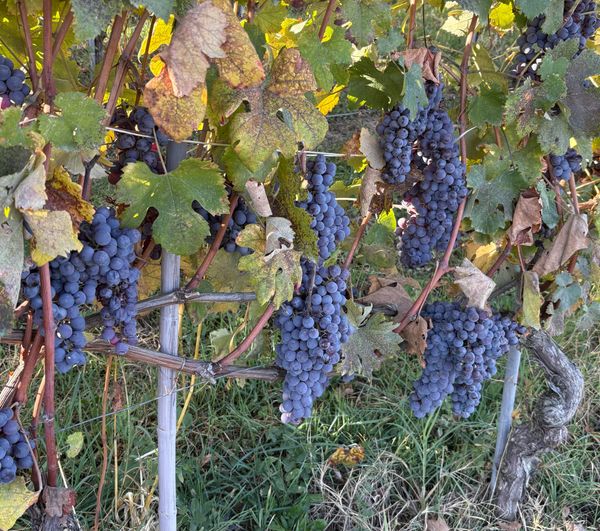
Heading east brings you to Vernazza, a village known for its colorful and elegant homes that takes its name in part from the indigenous wine, Vernaccia. About half the size of Monterosso, Vernazza has no car traffic and the only natural port of the Cinque Terre, making it an active fishing village. The hike from Monterosso to Vernazza is about 4.3 kilometers with the equivalent of climbing 65 flights of stairs.
Next after Vernazza is Corniglia, which sits atop a raised mass of rock that drops steeply into the sea. The village is at about 100 meters of elevation and has the smallest year-round population in the Cinque Terre. Getting there requires a climb up 383 brick steps! One day we took the train to Corniglia, walked up to the town, explored a bit, then hiked 3.5 kilometers over the hillside to Vernazza. My health app registered 70 flights of stairs that day; my poor glutes argued that was a gross undercount. Because of the terrain, Corniglia is the only Cinque Terre village with no marina and thus is not accessible by ferry.
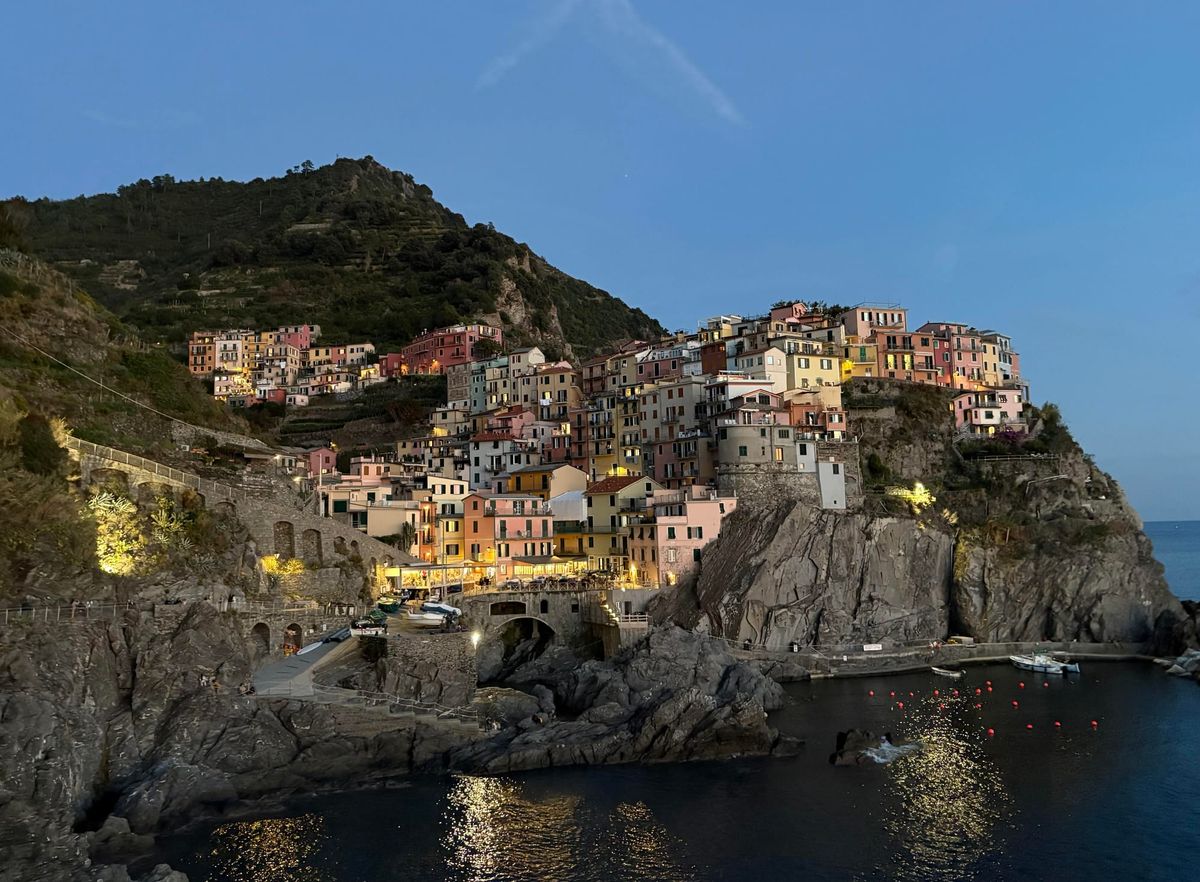
Continuing east is Manarola (pictured at dusk above), where our Airbnb apartment enjoyed a great morning view of the vineyards on the mountainside. The cornerstone of the main church there dates back to 1338, the oldest known marker in the Cinque Terre. A hike to Corniglia is nearly 7 full kilometers with the equivalent of climbing well over 100 flights of stairs. We started out that way on our first full day, then thought better of it and doubled back. In the other direction, Via dell'Amore ("Love's Trail") provides a very comfortable walk close to sea level from Manarola to Riomaggiore. The sunset views are incredibly romantic! A ticket is required to access Via dell-Amore (10 euros). Many hotels and Airbnb hosts provide a voucher that allows unlimited use of a single ticket for the duration of your stay. We took full advantage.
Finally, there is Riomaggiore. Its year-round population of approx. 1300 is nearly the same as Monterosso, making these two bookends the largest Cinque Terre villages. There's a popular small beach covered with smooth rocks there. We sat in the shade one day and marveled at several beachgoers who wrapped towels around their waists (bath-size towels, not large beach towels), then held the towel with one hand while maneuvering underneath with the other to remove underwear and pull up a bathing suit or bikini bottom. Marvelously efficient and mildly titillating! Riomaggiore also has the best marina for small boat or kayak rentals, and it was there that we boarded the local ferry for a pleasant ride up to Monterosso.
By the numbers:
39 flights of stairs, average per day during our time in the Cinque Terre
49 days into our trip so far
1,100 meters, length of Via dell-Amore from Manarola to Riomaggiore
4,000,000 tourists visit Cinque Terre annually (~1,000 times the permanent population)
As always, please share, comment and subscribe to have future posts delivered directly to your inbox.