du Pape

Greetings from Avignon, where it's raining today – perfect for writing a long post.
Technically, Avignon is the prefecture of the Vaucluse department in a region of southern France. That's the equivalent of being a county seat in the U.S. Situated on the left bank of the Rhône River, Avignon is one of few French cities to have preserved its medieval city walls and it was listed as a UNESCO World Heritage Site in 1995. Avignon hosts one of the world's largest performing arts festivals every July and is a popular stop for riverboat cruises along the Rhône.
It's a very old city, with references going back over 2500 years.
An hour of walking and bus rides up the road is the town of Châteauneuf-du-Pape, which we visited yesterday. The French phrase du Pape translates as "of the Pope" and this area (i.e., including Avignon) is perhaps the most "of the Pope" place outside of Rome. Châteauneuf-du-Pape (literally "the Pope's new castle") is, of course, famous for the wines produced there. (If you like red wine but never tried a Châteauneuf-du-Pape, stop reading right now and go find some. You can thank me later.)
Back in Avignon, in the historic city center, is the Palais des Papes (Palace of the Popes), a huge medieval Gothic palace overlooking the Rhône River, built in the early 14th century. Another UNESCO World Heritage Site, the construction of the palace nearly bankrupted the papacy.
So what is it with popes and wines in southern France?
At the start of the 1300s, there was a conflict between two powerful men with inflated egos. One was Pope Boniface VIII, an Italian who believed he should wield authority over foreign affairs in addition to spiritual matters. The other was France's King Philip IV, who believed the wealth of the church should support the state.
Philip IV expelled the clergy from any role in the administration of law, taxing them instead. Boniface issued an order preventing lay taxation of clergy without papal approval. Philip blocked certain exports that contributed to papal revenue. Their feud went on for several years. In 1302, Boniface attempted to reassert papal control over French clergy. Philip retaliated by preventing French clergy from traveling to Rome for the Holy See, the church's governing body. Boniface VIII retaliated by excommunicating Philip IV, who retaliated by sending agents to arrest Boniface in 1303. They held Boniface captive for several days and he died a month later. No pope since then has chosen Boniface as his papal name.
It's a good thing neither Philip nor Boniface controlled the Strait of Hormuz.
The next pope after Boniface only served for a couple years. At the following conclave, Philip IV pressured the papal conclave to elect a French archbishop as the new pope, who became Pope Clement V and refused to move to Rome. Eventually he settled in Avignon – then part of the Holy Roman Empire – as the first of a series of popes, all Frenchmen, to reside here rather than Rome.
This period from 1309-1376 is sometimes called the Babylonian Captivity of the papacy, and shows the French crown's dominance of Catholicism during that time.
(For nearly 40 years after Pope Gregory XI moved his court to Rome in 1376, there were two popes: one in Avignon (now regarded as illegitimate) and another in Rome. The details of schism, however, are beyond the scope of this post.
Back to the wine.
The second Avignon pope, John XXII, built a castle upon a hill in the area that is now the town of Châteauneuf-du-Pape, to serve as his summer residence. The area was already known for its viticulture and apparently this pope really enjoyed a nice goblet of vino. Even the bishop of Avignon owned a vineyard there. Before long, John XXII declared the local wines ‘Vin du Pape’ and arranged for them to be served at the Palais des Papes and gifted to visiting dignitaries.
There are many wineries and varieties of Châteauneuf-du-Pape that qualify for the official designation and use of the town's name, which was officially adopted in 1893. Tradition dictates specific grape varieties that may be used in Châteauneuf-du-Pape wines, although the grenache and syrah grapes are by far the most popular. So a Châteauneuf-du-Pape bottle of wine could be 100% grenache, 100% syrah, or any blend of these grapes as long as they were grown in the designated area.
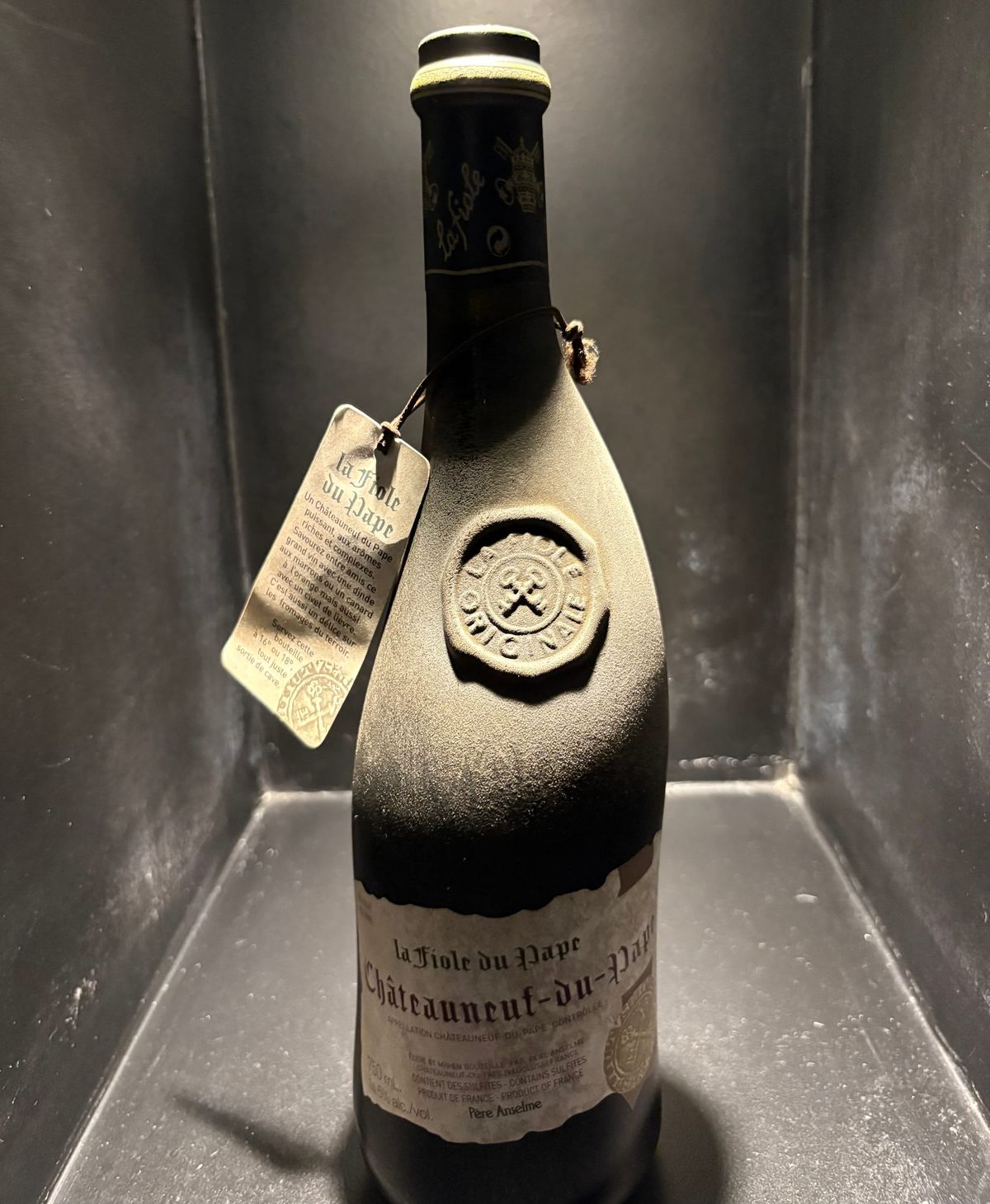
Today, the authenticity of each bottle of Châteauneuf-du-Pape wine is confirmed by a raised emblem representing a papal coat of arms. And the town of Châteauneuf-du-Pape is basically a working agricultural outpost, albeit with one wall of the castle still standing. We hiked up there to see it. There's a small town center, where we ate lunch, but not many tourists in late September. Numerous wineries offered tastings, which we partaked at the Wine Muesum Brotte. While we saw several tractors chugging up and down the roads, the peak harvest season had ended a week or two earlier. We could still smell the grapes!
And the Palais des Papes in Avignon is now a major tourist attraction, housing a large convention center, archives of the county government, and a research center on the papacy of Avignon. It's large courtyard serves as an outdoor performance location and the site of a concert we plan to attend an a few days.
Cheers! (Or "subscribe and imbibe!")
By the numbers:
3 days that King Philip's agents held Pope Boniface captive
7 consecutive popes who resided in Avignon in the 14th century
11 miles from Avignon to Châteauneuf-du-Pape
13 grape varieties that may be used in the production of Châteauneuf-du-Pape wines (Grenache, Syrah, Mourvèdre, Cinsault, Clairette, Vaccarèse, Bourboulenc, Roussanne, Counoise, Muscardin, Picpoul, Picardan, and Terret Noir)
93% of Châteauneuf-du-Pape is red wine (I don't recommend bothering with the whites)
180 (estimated) official estate-bottling wineries that currently produce Châteauneuf-du-Pape
12,423 steps yesterday
118,000 square feet in the Palais des Papes
12,000,000 (approximately) bottles of Châteauneuf-du-Pape produced annually
Don't forget to tell your friends!
![From [here] to [there]](https://storage.ghost.io/c/9f/87/9f8784a0-2eb2-48c4-958f-5c861ace35f4/content/images/size/w600/2026/10/Map-to-La-Morra.png)