Lyon's Delights

While our stay in Lyon was brief, it felt like a nonstop highlight reel.
The Saône and the Rhône Rivers run through the older part of Lyon before merging as the Rhône at the southwest corner of the city. If you've had Côtes du Rhône wine, you've had wine from the Rhône Valley, created by this river.
We stayed in Lyon's old town, known as Vieux Lyon, which is one of Europe's largest Renaissance-era sites and runs along the west bank of the Saône (with the Rhône) less than a half-mile further east. Vieux Lyon is full of charm, bustling with tourists on narrow cobblestone streets, charming courtyards and amazing restaurants. The most impressive architecture (predictably) appears in two churches: the Cathédrale Saint-Jean-Baptiste just a couple doors past our Airbnb and the Basilica of Notre Dame of Fourvière, a steep walk up the equivalent of approx. 30 flights of stairs (or a short cable car ride for those not wanting a "stairmaster vacation").
You might wonder – as I did – what's the difference between a cathedral and a basilica? A cathedral is the principal church of a bishop's diocese (or territory). Basilica is an honorary title given to a church or cathedral by the Pope for its special historical, spiritual, or architectural importance. The Notre Dames in Paris and Lyon are both basilicas, but only the one in Paris is a cathedral.
Our Airbnb host gave us several spot-on restaurant recommendations. The first night we feasted on Coq au vin, a French classic. Mmwah! The second night we started with "silk weavers' caviar," a tongue-in-cheek reference to lentil salad by people who cannot afford the real thing. Bonnie followed that up with shepherd's pie, while I opted for pike quenelle, a local classic dish that features a oblong dumpling-like wrapper stuffed with minced pike fish. Covered with lobster sauce, it was delicious.
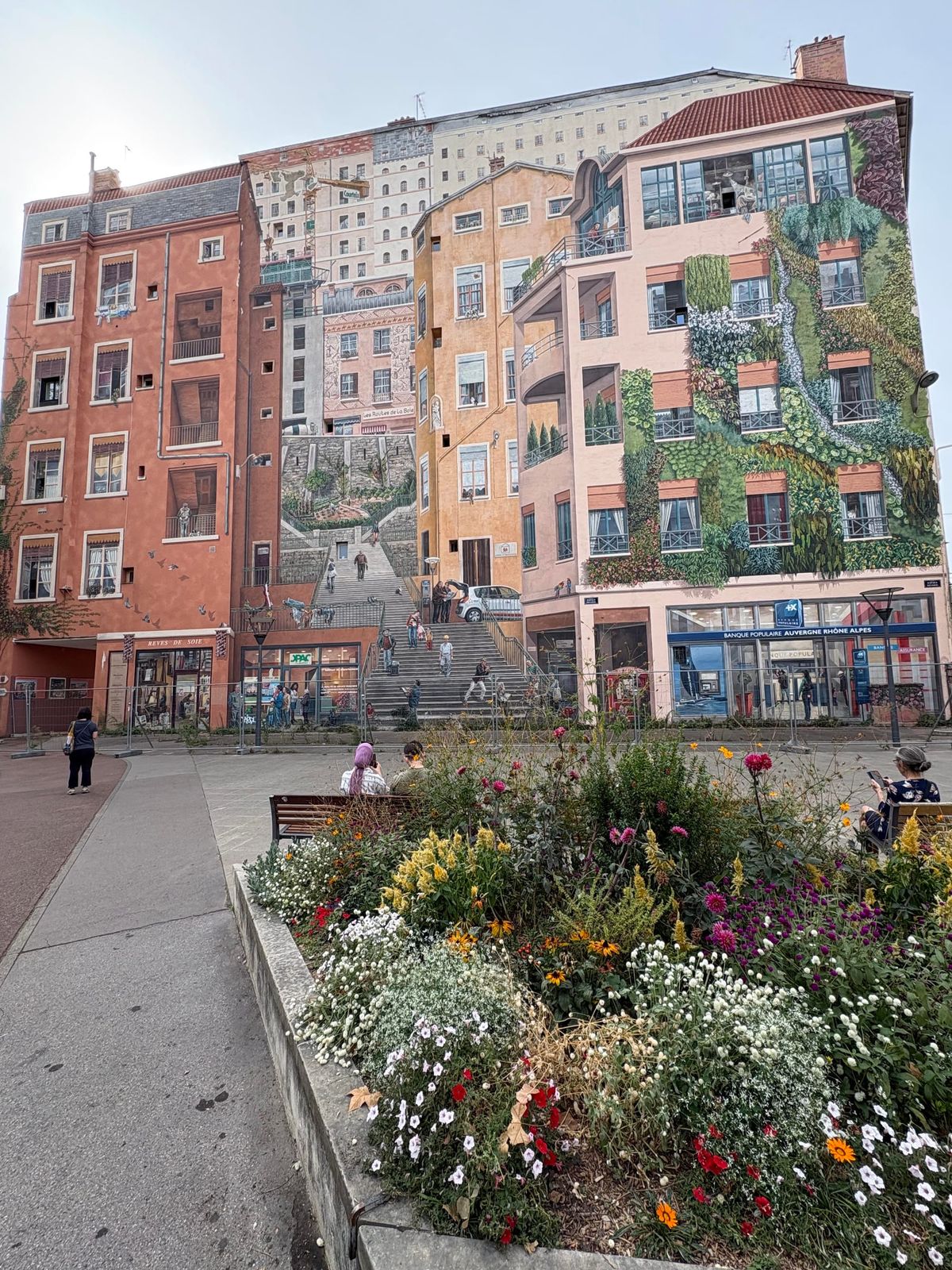
In the 1970s, a group of mural art students in Lyon set about getting their work in public spaces. Thus began Lyon's modern tradition of frescoes (massive public wall murals) and in the mid-1980s, the artists organized a muralist collective known as CitéCréation.
We checked out several of these frescoes, including the fantastic Silk-Weavers Wall) shown in the photo up top. The facing of this building is basically a wet lime plaster, with a few small windows. At first glance it looks like several apartment buildings with retail space on the ground floor and steps leading to more buildings up a hill. Look more closely. All of that is one giant mural, including what appears to be ground floor retail spaces.
Other frescoes we saw included the Fresque des Lyonnais and "The Library of the City." This embrace of public art was such a delight. You can see these and other works on the CitéCréation website.
After the frescoes, we walked across the Rhône to Parc de la Tête d'Or, a massive 19th-century park with statues, fountains, tall trees, a lake, a zoo, botanic and rose gardens and more. As soon as we entered, we were greeted by Vivre Ensemble (Living Together) a stunning open-air photography exhibition by renowned photographer Yann Arthus-Bertrand to showcase the diversity of French society.
The afternoon we spent meandering in the park was the most peaceful I've felt in several days. And you know how much that means to me.
By the numbers:
Nearly 100 monumental murals in Lyon
180 photographs in the Vivre Ensemble exhibit, some as large as 4 x 6 feet on sturdy, weatherproof panels, with striking colors and detail
290 acres to wander at Parc de la Tête d'Or
1,952 basilicas in the Catholic Church worldwide, including the four major basilicas in and around Rome, where we'll be in a few weeks.
19,747 steps yesterday