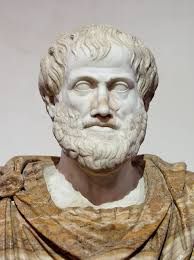
Aristotle!

On Tuesday, we decided to try take our minds off the U.S. midterm elections by hiking to the top of Lycabettus Hill, with the highest point in central Athens and breathtaking views in every direction.
The hill is behind the parliament building, which attracts a small crowd to Greece's Tomb of the Unknown Soldier memorial. We watched as an elite unit of the President Guard performed its hourly Changing of the Guard. The incoming and outgoing guards move in a deliberate, stylized choreography notable for sweeping leg extensions on every step, symbolic of pushing back enemy forces.
A block from parliament is the National Garden, a beautiful and peaceful escape full of palm trees in the heart of the city. We enjoyed the garden en route to the upscale Kolonaki neighborhood that includes numerous fancy shops, elegant homes and an embassy row.
Just before the serious part of the climb to Lycabettus Hill, BAM! Out of nowhere, we stumbled onto the archaeological site of the Lyceum of Aristotle. It's geographical disconnected from, and much smaller (at just 2.7 acres) than, the major attractions like the agora and acropolis. In college, Aristotle was my choice of "major philosopher" to satisfy my major requirements.
In 335 BC, Aristotle founded a school ("lyceum") on this site, which also served as a gymnasium in the classical Greek sense of boys exercising while naked. He ran it continuously for the next 12 years. His teaching style involved wandering the grounds with his students, resulting in the school being named Peripatos and the students referred to as Peripatetics. An inner circle of advanced students accompanied him in the mornings, with more general discourses in the evenings.
This is where Aristotle wrote, among other works, the Nicomachean Ethics, so named after his father Nicomachus, a prominent physician. In that work, Aristotle addresses the most fundamental questions of how people can live good and fulfilling lives. The goal is to flourish. The means to that goal is finding a "golden mean" or balance for each of the cardinal virtues –> courage, prudence, temperance, and justice. Having too much of a virtue can be as harmful as having too little. For example, too little courage leads to cowardice; too much courage leads to foolishness. If you like a 'moderation in all things' approach to life, and I do, welcome to the world of Aristotelians.
The Lyceum contained Aristotle's (and successors) large collection of manuscripts and maps, forming the first renowned library of antiquity and most important library of its kind in the ancient world.
We paid five euros for admission, went in and shortly came upon a marker that stated rather boldly these words upon which I cannot possibly improve:
"It is difficult to appreciate, from the scant archaeological remains on this site, that this spot is one of the most significant places in the history of mankind. Here the universal mind of Aristotle systematized the organization of 'kosmos' (beauty, world) viewing it in a more sober and analytical manner than Plato. The Aristotelian thought launching from empirical reality with scientific rigor and method studied and systematized Logic (reasoning), Ethos (Morality), Psychology, Metaphysics and Physics. His works on Logic were compile under the title Organon in Byzantine times. Physics includes works on practically all modern sciences, such as cosmology, mechanics, biology, anatomy, botany, astronomy. Moreover, Aristotle engaged in philosophical, historical and aesthetic studies, the latter comprising Rhetoric and Poetry.
"The monumental intellectual work of Aristotle and his companions summarized coherently all philosophical and scientific inquiries of the classical world. Aristotelian thought had an enormous impact on the formation of the Christian Patristic theology. For Christian Scholasticism and Medieval Arab philosophy, Aristotle was the epitome of human wisdom and the undisputed authority in every discipline for eighteen centuries."
In pop culture speak, Aristotle was the OG of GOATs.
We did make it to the top of Lycabettus Hill and the views were worth every arduous step.
By the numbers:
38 acres in the National Gardens, with something to please everyone
46 flights of stairs climbed
200-400 separate treatises or scrolls are estimated to have been written by Aristotle
277 meters above sea level at Lycabettus Hill's peak
17,583 steps
Enjoying this blog? Share, like, repost, comment, subscribe... all those things.