Ruins and Ruminations in Rome

Here are some random and sometimes conflicted observations on our first days in Rome.
Rome is a must-see city for a "Europe 101" trip, being the fifth largest in continental Europe, with perhaps the most historical significance. There's too much history to absorb it all, and also too much to try to experience Rome like the local population does.
Even in late October, Rome is noisy and crowded. Tourists are everywhere, there are many cars, and the only city in our retirement travels where we've seen more motorcycles was Medellin. Despite its reputation as a walkable city, crossing the streets is often terrifying, with numerous crosswalks at busy spots with no traffic light.
The pizza and pasta are amazing, as is the tiramisu and gelato. Our Airbnb, however, is in a multi-cultural / quasi-Chinatown neighborhood near the train station, which has a Five Guys Burger and Fries inside. I counted nine guys working when we had a comfort lunch there. The most brilliant and effective culinary marketing was at a pasta restaurant that positioned several women rolling out fresh pasta in a storefront window, instead of keeping these national treasures hidden back in the kitchen. Table for two, please!
We walked to the Vatican museums, in Vatican City, which – in a show of the Vatican's power – is a separate country inside Rome's city limits. The layout is a bit like an Ikea store, very crowded, one-way traffic through a complex maze with the promise of the Sistine Chapel at the end. Visitors to the Sistine Chapel must follow a strict, prudish dress code. Throughout the museums and in the Chapel, the marble sculptures, tapestries and paintings are truly amazing. The complex images, attention to detail by the artists, and technical skills on display – to have been produced so long ago – boggles the mind. What tools did these artists have? What training? The images portrayed fall into a certain pattern, however, dominated by the emergence of Christianity, much nudity with men's bodies depicted as thick and muscular and women's as soft and supple, conflict and violence, subjugation, and striking emotion on the faces of horses involved in struggle. I was struck by the irony of so many artistic depictions of nudity in a place that insists men not wear shorts and women not wear dresses that fail to cover their knees or bare shoulder blouses.
But I'm a fan of irony, the engine of great comedy.
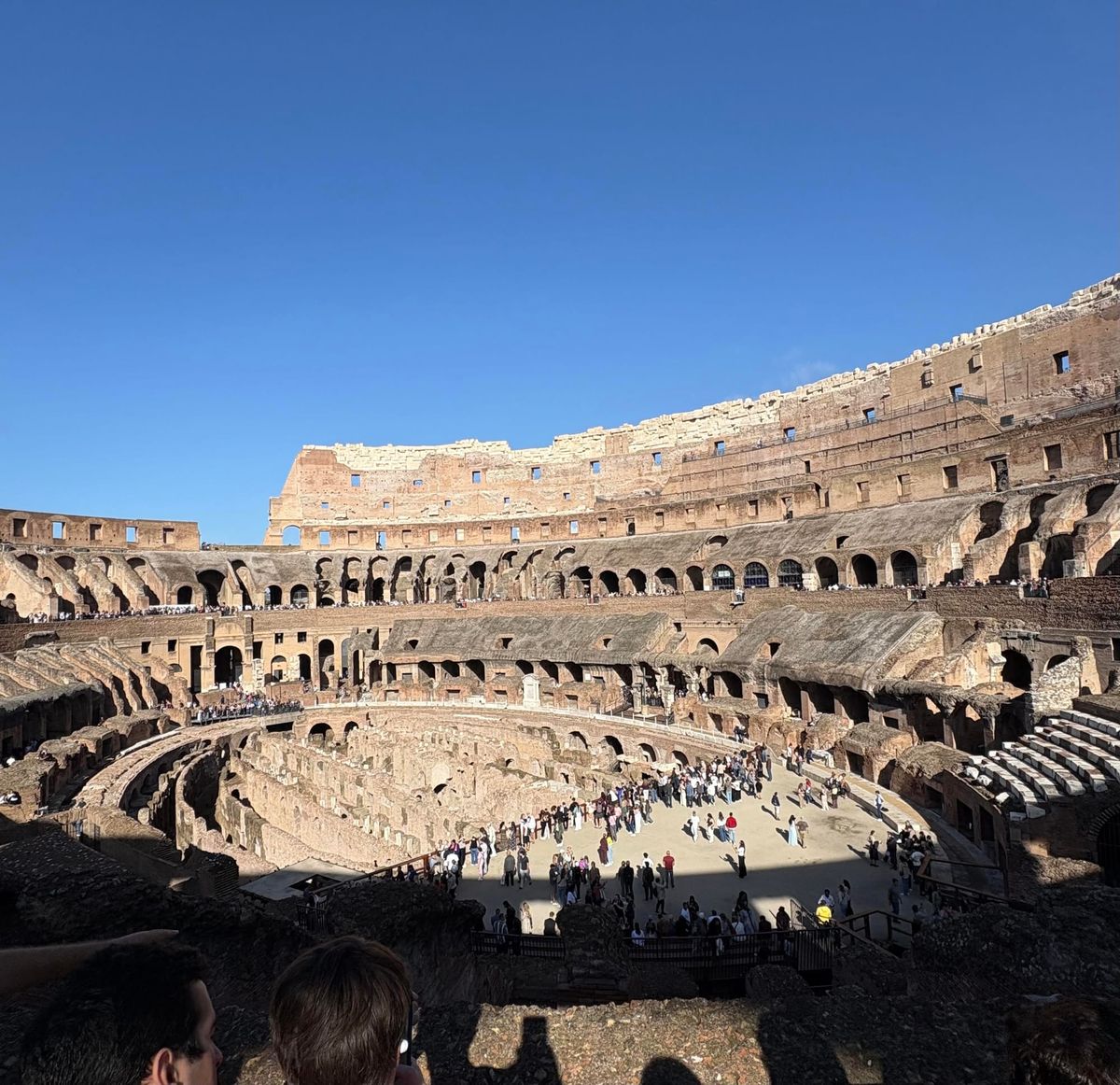
Ancient ruins are preserved and turned into tourist attractions all over the city. This is over 1,000 years old. That is nearly 2,000 years. You have to buy a ticket to get close to the ruins, lest people ruin them further. One spot looked like the Romans might have built a replica of the current East Wing of the White House! There are lessons to be learned from the history behind the ruins. If anything, they serve as reminders that entire civilizations can collapse, then something new rises again. I think about this a lot.
The collapse of civilizations isn't just a Roman thing either. Allow me to quote from Wikipedia:
"In his acclaimed 12-volume work, A Study of History (1934–1961), the British historian Arnold J. Toynbee explored the rise and fall of 28 civilizations and came to the conclusion that civilizations generally collapsed mainly by internal factors, factors of their own making, but external pressures also played a role. He theorized that all civilizations pass through several distinct stages: genesis, growth, time of troubles, universal state, and disintegration.
"For Toynbee, a civilization is born when a 'creative minority' successfully responds to the challenges posed by its physical, social, and political environment. However, the fixation on the old methods of the 'creative minority' leads it to eventually cease to be creative and degenerate into merely a 'dominant minority' (that forces the majority to obey without meriting obedience), which fails to recognize new ways of thinking. He argues that creative minorities deteriorate from a worship of their 'former self,' by which they become prideful, and they fail in adequately addressing the next challenge that they face."
It is a privilege to visit Rome and absorb its many sights and lessons. I wish doing so led to a greater sense of peace. In one plaza, there was a display containing flyers asking "Is peace on earth possible?" It makes me sad that the answer is so obvious.
By the numbers:
5 countries visited so far
66 basilicas in Rome
3,200 years (approximately) for the longest-standing continuous civilization still existing today... China
21,431 steps on our day at Vatican City
If you found this via social media, please note that not every post is shared that way; to have ALL posts delivered right to your email inbox, be sure to sign up below.