Say Cheese!

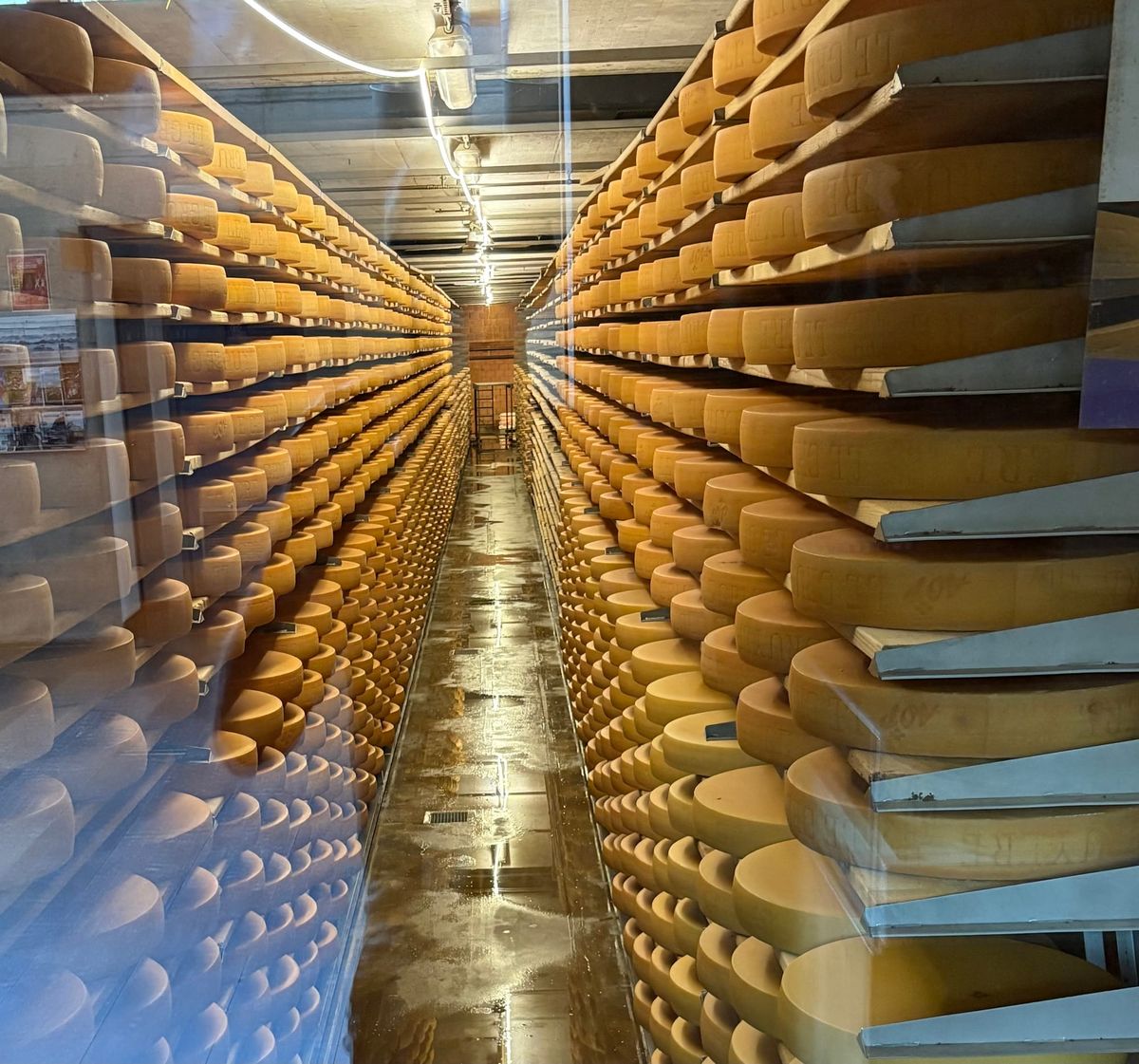
The GOAT of Swiss cheeses is Le Gruyère AOP (or simply "Gruyère"), with the entire world's supply of Swiss Gruyère being made at one modest looking cheese factory in the town of Gruyėre, nestled in the lower Swiss Alps. The longer the aging process--up to 24 months--the stronger the flavor. It's so good!
It takes a little over an hour to get there from Montreux, and the thrill of it all is that means riding The Chocolate Train, which offers a day trip to Gruyère and back, including a chocolate croissant on the ride, a Gruyère factory tour, lunch in the charming town center, and another factory tour at Callier Chocolates, Switzerland's oldest chocolate company.
The setting is idyllic. The mountain views are spectacular. The cows are plentiful, munching on alpine grasses and drinking water all day to be able to produce their milk. The cheese makers are experienced–Gruyère dates back to 1115.
It's hard for me to articulate just how good Gruyère cheese is. In the U.S., it's rather expensive. If you like cheese, get over it and buy some! Make sure it's from Switzerland as there's also some French-made Gruyère on the market. And try it for yourself.
After Gruyère, The Chocolate Train experience took us to Callier's main chocolate facility, about 12 minutes away. Chocolate beans were originally brought to Europe by Cortés, who likely stole them from the Aztecs. Eventually they made their way to Switzerland, where Fraçois-Louis Callier and other Swiss entrepreneurs (along with Daniel Peter and Henri Nestlé) added milk, to make milk chocolate. This proved to be a game-changer in converting a somewhat bitter product with niche appeal into an item popular with the masses. Callier began operations way back in 1819.
Let me tie this together just a bit. To make milk chocolate, you need milk, therefore milk cows, which happened to be plentiful near Gruyère. Voila!
By the numbers:
25 liters of milk produced by each of Gruyère's cows daily, on average
85 liters of water drank by each of those cows daily, on average
100 kg of grass eaten by each of those cows daily, on average (I suppose zero is the number of other activities of said cows, but I digress)
400 liters of milk needed to make one 35 kg round of Gruyère AOP cheese (AOP is an acronym for a French term that translates as Product Designation of Origin, widely used in Europe to indicate the protection of origin and quality of traditional food products)
500 tons of Gruyère cheese produced annually
12,735 steps today
9,150,000 – estimated population of Switzerland, which has the best cheese, the best chocolate, the best army knives, the best watches, the best banks, the United Nations, UNICEF, Red Cross and World Health Organization, the best physics at CERN, and the Swiss Alps
11,200,000 – estimated population of North Carolina, where we lived from 2003 until earlier this year, which has the best college basketball, Bank of America and also Mount Mitchell
Comment, share, subscribe, etc. if you enjoyed this post.