The Enlightment
You might not have known that, in college, I majored in philosophy. Now you do.
One of the great philosophers of the 18th century Age of Enlightenment was Jean-Jacques Rousseau, born in Geneva where his father and uncles were watchmakers. Today we returned to the Peace Capital (i.e., Geneva) from Montreux and booked a room at Hotel Rousseau, on Rousseau Street, with the idea of educating ourselves more on Rousseau's philosophies.
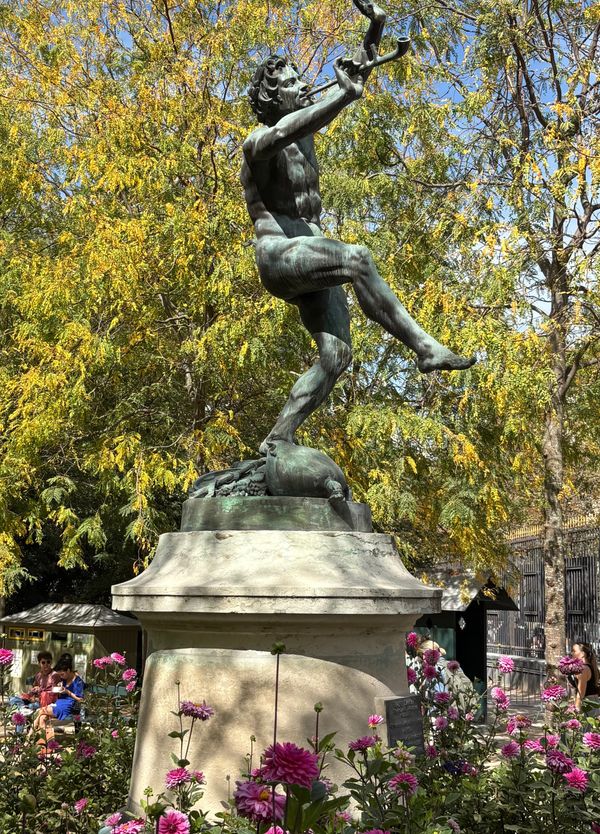
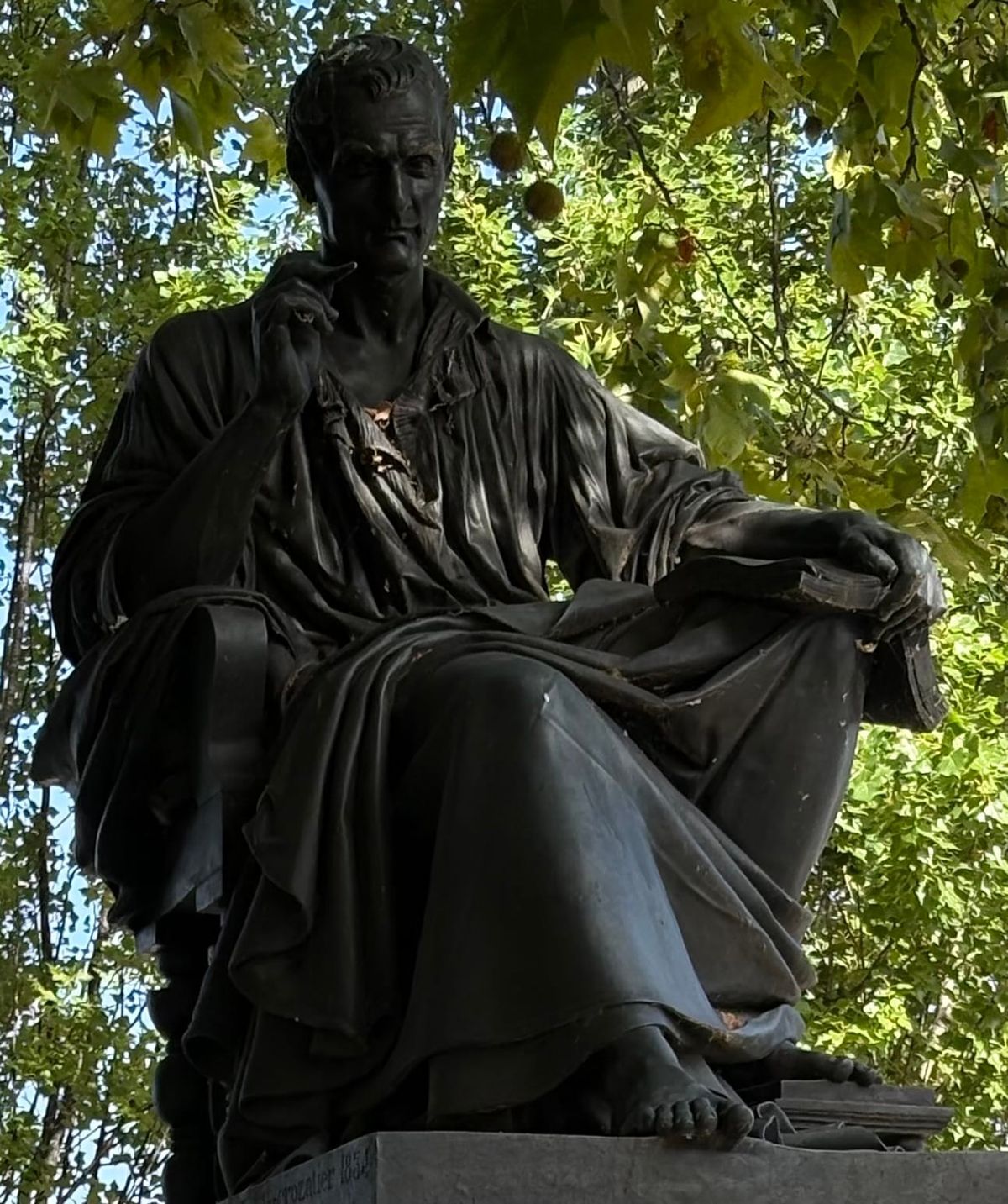
Seriously, if you have both a hotel and a street named after you 250 years following your death, that automatically qualifies as greatness. There's even a Rousseau Island in the harbor, featuring the statue pictured above.
"Has the restoration of the sciences and arts contributed to the purification of morals?" This prompt, from a competition of the Academy of Dijon, lead to Rousseau's winning essay A Discourse on the Moral Effects of the Arts and Sciences, in which he proffered that advances in civilization were a destructive force on human beings. He believed the natural state of humans was good and "it is from these institutions alone that men become wicked." Thus he became one of the first writers in (then) modern democratic thought to criticize openly the social costs associated with scientific progress.
And that was before AI took over!
In 1754, Rousseau wrote his Discourse on Inequality in response to another contest prompt: What is the origin of inequality among people, and is it authorized by natural law? Here he concludes that private property is the origin and source of all inequality. And what better day than Labor Day (in the U.S.), to revisit this argument, which basically went like this: Moral inequality is unique to civil society, made up of differences in wealth, status, power and personal merit. Civil society, be wrote, pulls humans away from their natural state, which is simple, uncivilized, empathetic, and preoccupied with self-preservation.
Once people congregage and a society develops, individuals start comparing themselves to others, leading to vanity and/or jealousy. Then he imagines the original foray into private property: "The first person who, having enclosed a plot of land, took it into his head to say this is mine and found people simply enough to believe him, was the true founder of civil society." From civil society emerges evils such as slavery, despotism and corruption.
"Men are wicked," said one visitor in his later years.
"Men are wicked, yes, but man is good," replied Rousseau.
Several years later, Rousseau wrote The Social Contract, which theorizes how to govern a political community in a way that is compatible with individual freedom and doesn't make inequality worse. He argued against the notions that monarchs are divinely empowered or the ability to coerce confers legitimate power, and that only the general will of the people should inform legislation, which must serve the common good.
Rousseau also objected again to extreme wealth inequality. Maybe he was right... aren't advances in science and technology responsible for the surge in wealth inequality we see in the 21st century?
In another work, On Education, Rousseau described all religions as equally worthy in terms of leading people to virtue, so people should simply stick to the religion in which they were raised. He also rejected original sin and divine relevation. This infuriated both Protestant and Catholic religious authorities and the French parliament.
Isn't it a fair question, though, whether efforts by various religions to convert non-believers and followers of other faiths have done more harm than good over the centuries? Rousseau's books were burned, warrants were issued for his arrest, and he was banned from both France and Geneva.
But that was prior to his works' inspired the leaders of the French Revolution and influenced those who argued–following the American Revolution–for a strong federal government, albeit with equally strong checks and balances on executive power.
By the numbers (limited edition today):
5 children Rousseau fathered out-of-wedlock with his longtime partner, Thérèse Levasseur, all of whom were placed in an orphanage
100 songs composed by Rousseau, in addition to two symphonies and a one act opera
18,441 steps today
Loving this blog? Pass it on.